









Least Common Denominator Calculator
Parse comma-separated fractions and mixed numbers to find the LCD. Validates denominators and applies prime factorization for precise results. Compute now.
Please configure parameters and execute the action.
About Least Common Denominator Calculator
Use this calculator to find the lowest common denominator across fractions, mixed numbers, and integers. It is useful when preparing fractions for addition, subtraction, or comparison.
How to Use
Enter values separated by commas.
- Type integers, simple fractions, or mixed numbers.
- Separate each value with a comma.
- Calculate to get the LCD and the denominators used.
Examples
-
Fraction list
Data Set: 3, 3/8, 1 1/2, 5/4

LCD: 8
Real-World Usage Scenarios
- Imperial Measurement Alignment - Standardize fractional measurements in woodworking or construction when working with blueprints that mix 1/8, 1/16, and 1/32 inch increments.
- Recipe Scaling and Catering - Convert multiple fractional ingredient quantities to a common base to simplify bulk purchasing and preparation for large-scale events.
- Fraction Comparison - Determine which ratio or measurement is larger by normalizing the denominators, essential for precision engineering and data analysis.
- Curriculum Development - Create and verify answer keys for complex mathematical problem sets involving addition and subtraction of unlike fractions.
Frequently Asked Questions
What is the difference between LCD and LCM?
The Least Common Denominator (LCD) is specifically the Least Common Multiple (LCM) of the denominators in a set of fractions.
How do I format mixed numbers for calculation?
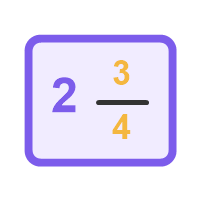
Enter mixed numbers with a space between the whole number and the fraction, such as 2 3/4.
Can the tool handle negative fractions?
The calculator focuses on the absolute value of the denominators to find the LCD, as denominators are typically expressed as positive integers.
How are integers treated in the data set?
Integers are automatically treated as fractions with a denominator of 1.